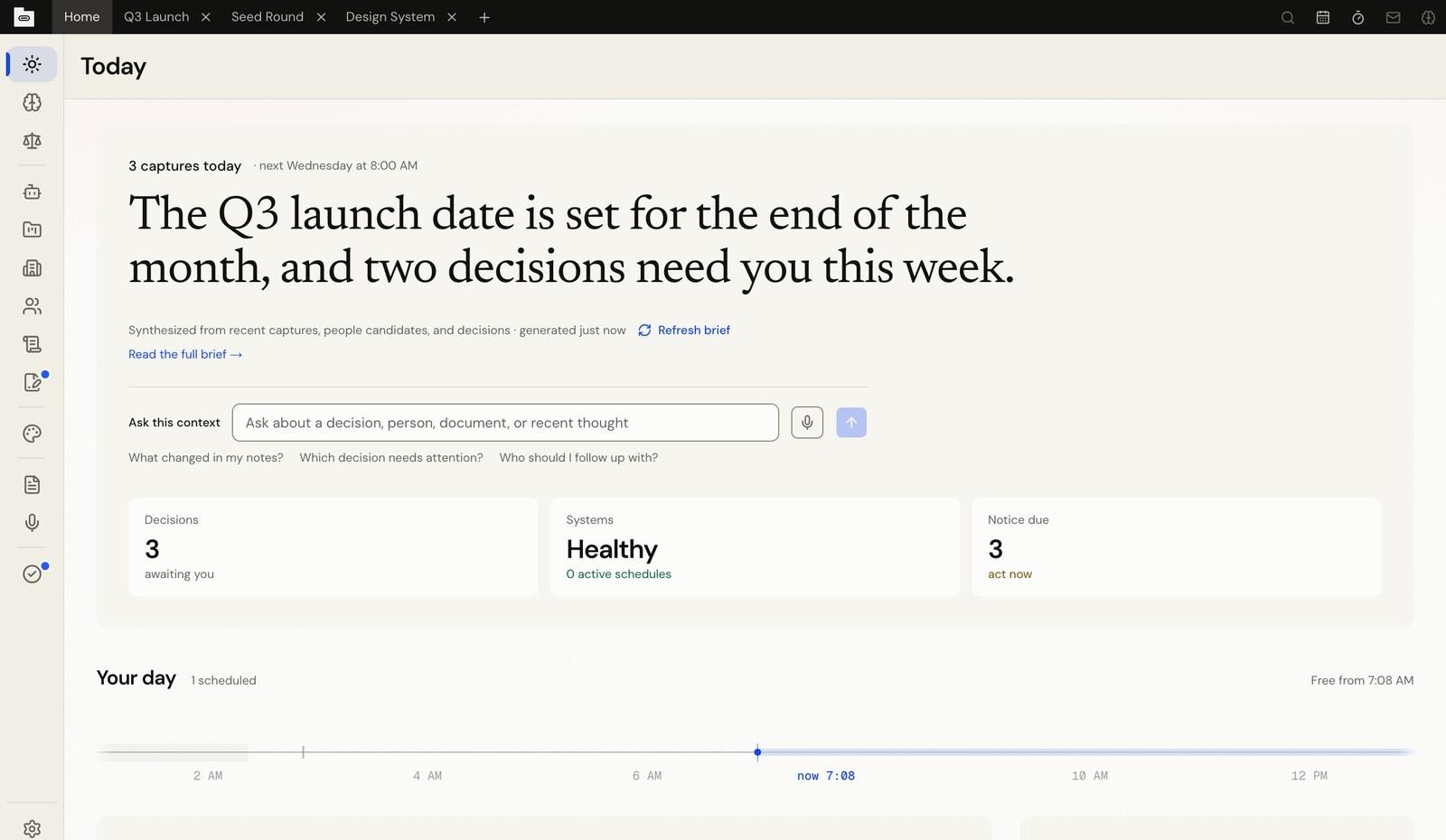
The experience is not the interface.
Thoughtstead is the workspace for designing how people and AI share the work, then getting the people ready: the training, the champions, the change. From the first question to a system someone can run and a team that can run it. Every consequential action waits for a person.
$19.99/month
One planExport any time
AI is now partof the system.
An experience is a person’s relationship with a system in operation, and AI now recommends, decides and acts inside it. So the work starts with the system: who decides, what the AI knows, who can stop it. The interface is where the answers show up.
Built for the person who has to make AI work for the people who use it.
Not a chat assistant and not a general notes app. For design work that ends in a decision someone is accountable for.
You’ve been asked the question.
A leader wants AI in the work and you have to say where it belongs, where it doesn’t, and why, with evidence rather than enthusiasm. And then you have to make it stick.
You run engagements for clients.
You take a client from a vague ask to a working system and a team that uses it. You need the findings, the business case, the training, the pilot and the adoption plan in one place, one workspace per client.
You do the same work inside a company.
Same questions, same decisions, for your own teams. The workspace doesn’t care which side of the contract you’re on.
Eight phases. The technology is half of them.
Most AI projects plan the build and hope the people follow. Here training starts before the system exists, and adoption is measured, not assumed.
Identify objectives
Diagnose where the client is and state the objective the engagement serves.
Map processes
Stakeholders, processes, shadow AI use, and five dimensions of maturity.
Prioritize opportunities
Score a first wave, and keep a deferred list with the conditions for bringing each back.
Activate training
Role-based capability that starts before go-live and completes at it.
Construct pilots
One pilot, real cases, the real workflow, written gates through a day-90 value gate.
Trace governance
An AI inventory, monitoring, the obligations that apply, an acceptable-use policy, sized to the client.
Accelerate adoption
Champions, redesigned workflows, change communication that says who does what, measured uptake.
Iterate and scale
Permanent capability, controlled steps in autonomy, the next wave.
Price the mistake before you build the system.
AI doesn’t have to be perfect. It has to beat the alternative. The Value Matrix sets what the AI is expected to get right and wrong against a human baseline, so “is it worth it” becomes a number someone can argue with. It lists the assumptions that still need research, so nothing hides in the model.
Against a human baseline
Measured against what people do today, not against zero.
Break-even
What would have to be true for the answer to change, and the point where the AI starts to pay for itself.
The most serious error
Named, with the human control that catches it.
Everything the work needs. Nothing happens without you.
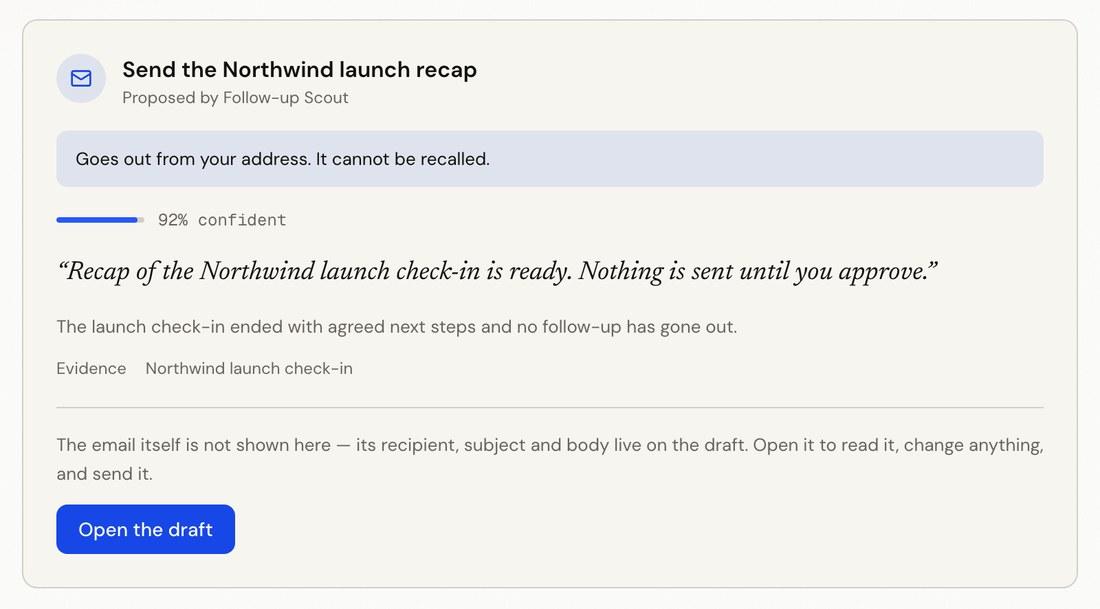
Authority lives in the system, not in a prompt. Anything that sends, shares or deletes waits for a person.
Make the boundaries explicit
You choose how much your own AI may do.
Keep the reasoning reviewable
Every decision keeps what was known and why.
Keep consequential actions accountable
Approvals and an audit trail record who allowed what.
Capture anywhere
Voice, text, meetings and documents go in raw first, so nothing is lost before it is understood.
A workspace per client
Each client, company or product gets its own isolated context. Search and agents never cross the wall.
The tool and the thinking come from the same place.
Thoughtstead is where the AI Experience Architecture method is put to work. The method is written up in the BFL Framework, from capability and decision architecture to governance, authority and trust. The workspace is where you run it on a real engagement.
The BFL Framework
The method, chapter by chapter: capability, decisions, workflow, governance, authority and trust.
AI Experience Architecture
The discipline in short: the experience is the relationship with the system in operation, and AI is now part of it.
Learn with BFL
Programs, the primer and the tool index from Big Freight Life.
Built for the desktop. Open on the web.
The desktop app is where Thoughtstead works hardest. Everything it does is also in your browser, with the same workspaces and the same pages.
- Capture the roomRecord and transcribe the meeting you are in, or any audio your Mac is playing.
- One keystroke awayLive in the menu bar and get a thought down before it is gone.
- Your own AI, built inUse the Claude Code or Codex you already pay for, inside Thoughtstead’s own tools.
Mac first, with Windows to follow. Launching soon.
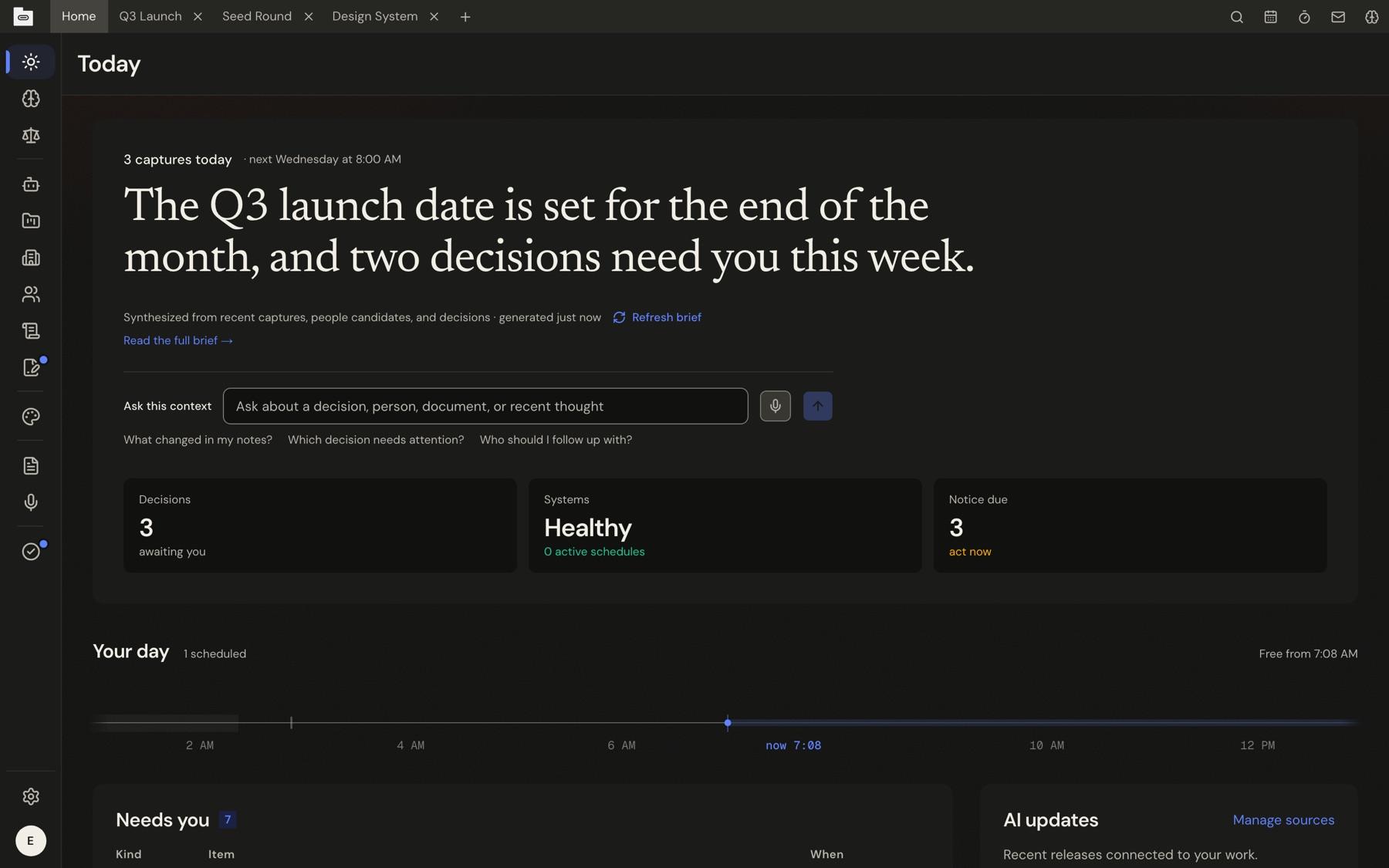
One workspace for the whole engagement.
One subscription for the workspace, project work and client delivery. Search and enrichment are included. For agent work you bring your own Claude Code or Codex. No tiers, and your data exports in one click.
- Every surfaceThe studio, and the rest of it
- Search and enrichment includedNo API key to manage. Agent work runs on your own Claude Code or Codex
- Every contextAs many as the things you run
- GuestsComment on a concept without a seat
- ExportEverything, one click, any time
Questions before you begin.
01What is Thoughtstead?+
The workspace for AI Experience Architecture. It holds an engagement from the first question to a team that is running the system.
02Is it only for deciding whether to do an AI project?+
No. That is the first third. It also covers training, the pilot, governance, change management and the next wave.
03Who is Thoughtstead for?+
People who have to make AI work for the people who use it: consultants and architects with clients, and teams doing the same work inside a company.
04How is it different from Figma, Linear or Notion?+
Those hold screens, tickets and documents. This holds the reasoning, the roles, the training and the approvals around an AI system, and it knows the shape of an engagement.
05How are AI actions kept accountable?+
Agents prepare the work. Anything that sends or deletes waits for you to approve it, and every step leaves a record.
06What are the Delivery desk and the Coach?+
The Delivery desk shows, client by client, where each engagement stands and what needs you. The Coach is plain rules that point out gaps as you fill the record in, such as a condition that could never fail, and never fill them for you. The desk is driven by your own Claude Code or Codex. The Coach needs no AI.
07Can I use my own AI?+
Yes. The Claude Code or Codex you already use can work inside Thoughtstead, with only Thoughtstead’s tools. It reads your workspace and makes changes you can see. Anything that sends or deletes waits for your approval.
08Is there a desktop app?+
Yes, for Mac first, with Windows to follow. It records the meeting you are in, lives in the menu bar, and runs your own AI. Everything it does is also in the browser.
09Can I bring clients and collaborators into the work?+
Share a concept with a read-only link so guests can review it and leave comments without needing a paid seat.